Cleaning supplies checklist: what each cleaner is for and how to use them safely

Quick answer: most homes need an all-purpose cleaner, a bathroom cleaner, a floor cleaner that suits your floors, microfiber cloths, non-scratch scrub pads, a mop and a laundry detergent that matches your washer. Read every label for the surfaces it is meant for, never mix products, especially bleach with ammonia or acids, and store everything up high and out of reach of children and pets.
A crowded cleaning closet often has five sprays that do the same job and none that does the one you need. Building the kit around rooms and surfaces keeps it smaller, less costly to refill and easier to use.
All-purpose cleaner for everyday surfaces
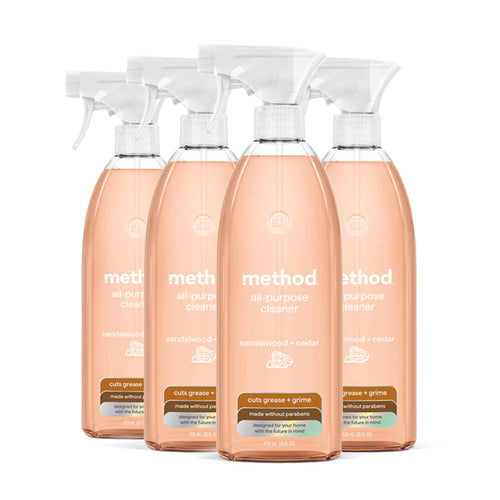
An all-purpose spray handles counters, tables, appliance fronts and sticky handles. Check the label for surfaces it should not touch: natural stone such as marble and granite often needs a pH-neutral product, and some sprays are not meant for food-contact surfaces without rinsing. The Method all-purpose spray four-pack covers daily wipe-downs, and concentrates such as Mrs. Meyer's multi-surface concentrate mix with water in reusable bottles, which cuts down on plastic and storage space. Dilute concentrates exactly as the label says; stronger is not better and can leave a sticky film. Browse all-purpose cleaners.
Cleaning versus disinfecting
Cleaning removes dirt and grime; disinfecting is a separate step that uses a product registered with the EPA for that purpose. Disinfectant labels show an EPA registration number and a contact time, the number of minutes the surface must stay wet for the product to work as directed. Spraying and wiping straight away usually cleans rather than disinfects, so follow the label directions exactly.
Bathroom cleaners and tools
Bathrooms mix soap scum, hard-water spots and mildew, which is why dedicated cleaners exist. A toilet wand with disposable heads keeps the brush out of the cabinet; the Clorox ToiletWand kit comes with 16 refill heads. Run the fan or open a window while you clean, and keep bleach-based and acid-based products apart. See bathroom and toilet cleaners.
Floors: match the cleaner to the surface
Sealed hardwood, laminate, vinyl and tile each have their own needs. Wood and laminate do not like standing water, so use a light spray and a damp, not wet, mop, and choose a cleaner labeled for wood on wood floors. For tile, vinyl and sealed stone, the Bona multi-surface floor cleaner refill is rinse-free and unscented, and the Bona Multi-Surface spray mop with an 18-inch washable pad applies it evenly. Browse floor cleaners and mops and refills.
Cloths, sponges and scrub pads
Microfiber cloths pick up dust and grime with little or no product and can be washed many times. Wash them without fabric softener, which coats the fibers. For mirrors and glass, a tight-weave cloth such as the E-Cloth glass and polishing four-pack leaves fewer streaks. For stuck-on food on pots and stovetops, non-scratch pads like the Scotch-Brite Dobie 24-pack are gentle on most finishes. See microfiber cloths and sponges.
Laundry basics
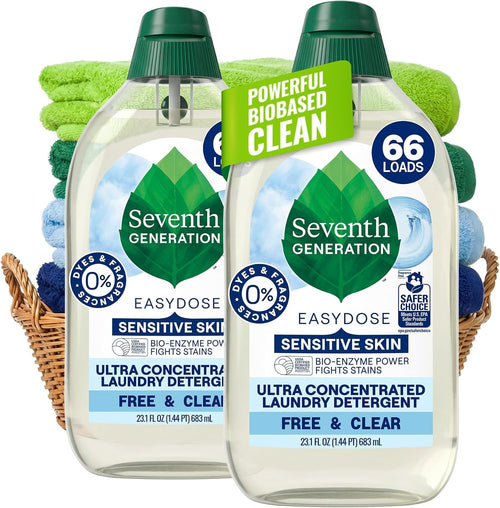
If your washer carries the HE symbol, use detergent marked HE, which makes fewer suds. Measure by the load size and soil level rather than filling the cap, since extra detergent can leave residue. Fragrance-free and dye-free options suit people who prefer unscented laundry; the Seventh Generation EasyDose Free & Clear is an 8X concentrate with a squeeze-dose bottle. A powder booster such as OxiClean Triple Action Free helps with stains on washable fabrics. Browse laundry detergent.
Safe storage
Keep cleaners in their original containers with the labels intact, closed tightly and stored up high or behind a latch if children or pets are in the home. Laundry pods in particular should stay sealed and out of sight of small children. Save the Poison Control number, 1-800-222-1222, in your phone.
Before you buy: a short checklist
- Walk each room and note the surfaces: stone, wood, glass, tile.
- Choose one all-purpose spray and one bathroom cleaner.
- Pick a floor cleaner made for your main floor type.
- Stock microfiber cloths and non-scratch pads.
- Check your washer for the HE symbol.
- Plan a high shelf or latched cabinet for storage.
Common questions
Can I mix cleaning products to make them stronger?
No. Mixing products can release harmful gases; bleach combined with ammonia or with acids such as vinegar is a well-known example. Use one product at a time, rinse between them and keep the room ventilated.
What does contact time mean on a disinfectant?
It is how long the surface must stay visibly wet with the product for it to disinfect as the label claims. It is printed in the directions and is often several minutes.
Do I need HE detergent?
If your washer has the HE symbol, yes. HE detergent makes fewer suds, which high-efficiency machines need to rinse properly. Too much suds can leave residue and strain the machine.
How often should microfiber cloths be washed?
After each cleaning session, or sooner if they are visibly dirty. Wash them warm without fabric softener or dryer sheets and let them air dry or tumble dry on low.
Keep browsing
All of these supplies are part of our Health & Household department. If floors are your biggest job, our shop by department page also leads to vacuums and floor care in Home & Kitchen.
Other Center ships every order to U.S. addresses with free standard shipping. Orders leave us within 1–3 business days and usually reach you 3–7 business days after that, a little longer for Alaska, Hawaii and Puerto Rico. Unused items in their original condition can be sent back free for 30 days from delivery using a prepaid label. See shipping and returns for the details.